
Delaware Traffic Court Records
Delaware traffic court records are official documents from cases heard across the state's Justice of the Peace Courts, Court of Common Pleas, and local Alderman's Courts. These records cover citations, case outcomes, fines, and dispositions for motor vehicle violations in all three counties. Most traffic cases in Delaware are treated as criminal matters, not civil infractions, which shapes how the records are created and where they are stored. You can search Delaware traffic court records online through CourtConnect or request copies directly from the court that handled your case. This guide explains where records are kept, how to find them, and what your options are.
Delaware Traffic Court Records at a Glance
Delaware's Traffic Court System
Traffic violations in Delaware run through a multi-tier court system, and most of them are treated as criminal offenses from the start. The Justice of the Peace Court is the court of original jurisdiction for nearly all non-felony motor vehicle cases. That includes routine speeding tickets, license violations, and misdemeanor offenses committed behind the wheel. It also covers traffic violations by drivers aged 16 and 17, unless the Family Court has jurisdiction over the matter separately. Every county has Justice of the Peace Court locations, and each one processes its own local case files.
The Delaware Justice of the Peace Court handles the bulk of traffic cases statewide. It is an entry-level court that moves quickly and hears a high volume of motor vehicle matters each year. Drivers who lose their cases can appeal to the Court of Common Pleas. That appeal is heard fresh, meaning the Court of Common Pleas conducts a new trial rather than reviewing what happened in the lower court. Under Title 21, Chapter 7 of the Delaware Code, all courts in the state must report traffic conviction records to the Division of Motor Vehicles within 30 days of a case's disposition. Alderman's Courts must do so within 10 days for moving traffic violations.
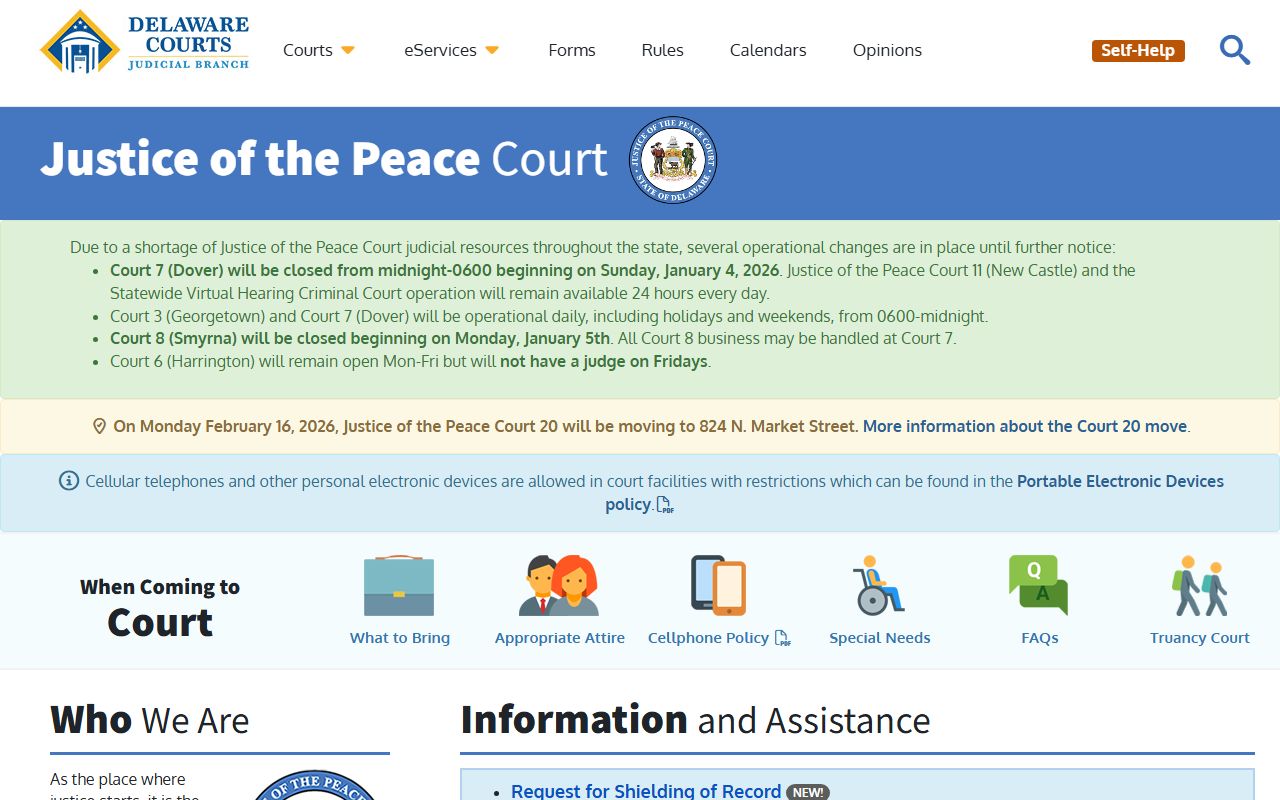
The official Delaware Justice of the Peace Court page provides court locations, jurisdictional details, and guidance for anyone looking into traffic court records statewide.
Delaware's court structure includes six courts in total: the Supreme Court, Court of Chancery, Superior Court, Family Court, Court of Common Pleas, and the Justice of the Peace Court. For traffic records, the courts that matter most are the Justice of the Peace Court and the Court of Common Pleas, along with Alderman's Courts in certain municipalities. All three counties rely on this unified structure, with records flowing up through the same appellate chain.
Courts That Handle Traffic Cases in Delaware
Three types of courts generate traffic court records in Delaware. The Justice of the Peace Court sits at the base and processes the largest volume of cases. Drivers arrested without a warrant for a traffic violation must have their cases heard before a Justice of the Peace in the county where the violation occurred, or the nearest county if that location is closer. This court has concurrent jurisdiction with the Court of Common Pleas Traffic Court in New Castle County for most vehicle matters.
The Court of Common Pleas Traffic Court sits one level above the JP Court. In New Castle County, it shares jurisdiction over traffic matters and handles DUI cases, driving-after-judgment violations, and appeals from JP Court decisions. This court combines arraignment and trial into a single court date for most traffic matters, which speeds up the process. Traffic cases in New Castle County's Court of Common Pleas are typically scheduled on Tuesdays. Defendants who need to postpone a traffic trial must notify the court in writing at least three days ahead. Requests for copies go to the Records Custodian at the Leonard L. Williams Justice Center, 500 North King Street, Wilmington, DE 19801. The Court of Common Pleas also has locations at the Kent County Courthouse, 414 Federal Street, Dover, DE 19901, and at the Sussex County Courthouse, 1 The Circle, Suite 1, Georgetown, DE 19947.
Note: The Court of Common Pleas cannot accept appeals for driving under the influence or driving after judgment is prohibited, so those cases require different handling from standard traffic matters.
Alderman's Courts and Municipal Traffic Records
Delaware has six active Alderman's Courts, and they operate under town charters rather than the standard state court rules. These courts handle traffic offenses, parking violations, and minor misdemeanors that occur within city or town limits. Four of the six are in Sussex County, in Bethany Beach, Laurel, Dewey Beach, and Rehoboth Beach. Two are in New Castle County: Alderman's Court 40 in Newark and Alderman's Court 42 in Delaware City (with one also operating in Newport). Their authority ends at the city or town boundary.
Alderman's Courts are not courts of record. They do not produce verbatim transcripts of proceedings. Audio recordings may be kept in some instances, but appeals from any Alderman's Court decision go to the Court of Common Pleas as a fresh trial within 15 days. Any convicted defendant has the right to appeal upon posting a $500 bond. Convictions for moving traffic violations must be forwarded to the Division of Motor Vehicles within 10 days of the case's disposition. To get records from an Alderman's Court, contact the clerk of that specific court by mail, fax, or in person with a written request.
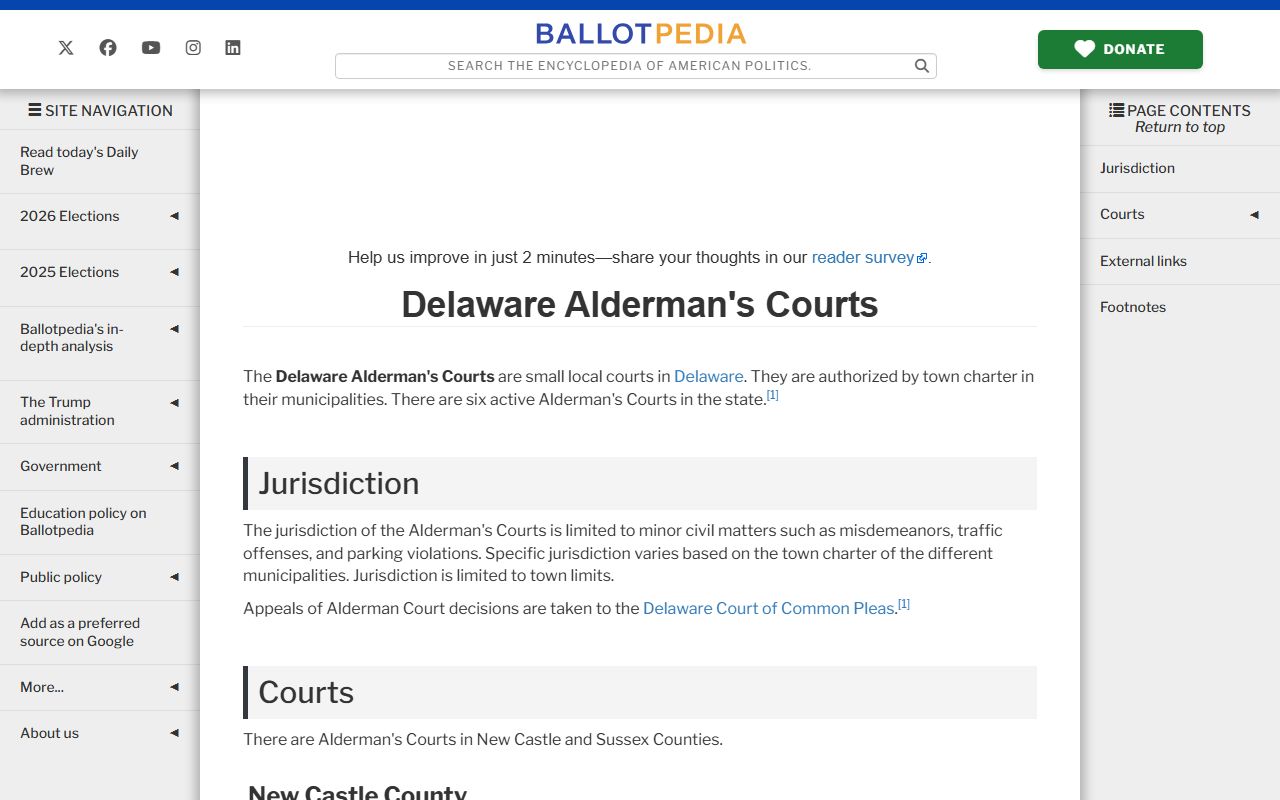
Ballotpedia's overview of Delaware Alderman's Courts identifies all six active courts, their locations across New Castle and Sussex counties, and the scope of their authority over local traffic matters.
Search Delaware Traffic Court Records Online
The main tool for searching Delaware traffic court records online is CourtConnect, the official case search system run by the Delaware Judiciary. It gives free public access to case information from the Superior Court, Court of Common Pleas, and Justice of the Peace Court. You can search by person name, business name, or case type. Results show party names, case numbers, filing dates, case status, and docket entries. You can also look up judgments against a person or business. CourtConnect is available 24 hours a day with no login required for basic searches.
When searching by name, type in the defendant's name and choose the relevant case type. The system pulls all matching records from participating courts. Once you find a case, clicking the case number gives you a full docket report that includes court dates, judgments, and any related cases linked to the same defendant. CourtConnect restricts access to driver's license numbers, witness and victim records, mental health commitment data, and medical records. Those items are not visible in public searches regardless of who submits the request.
CourtConnect is the Delaware Judiciary's public search system, providing free 24-hour access to case information from multiple courts across all three counties.
For civil traffic cases specifically, the Delaware Civil Case Search portal at courts.delaware.gov allows searches by name, case type, and case number around the clock. This tool returns civil case status, party details, scheduled hearings, and disposition records. Criminal traffic cases tracked through CourtConnect include many of the standard motor vehicle violation matters heard in JP Courts statewide.
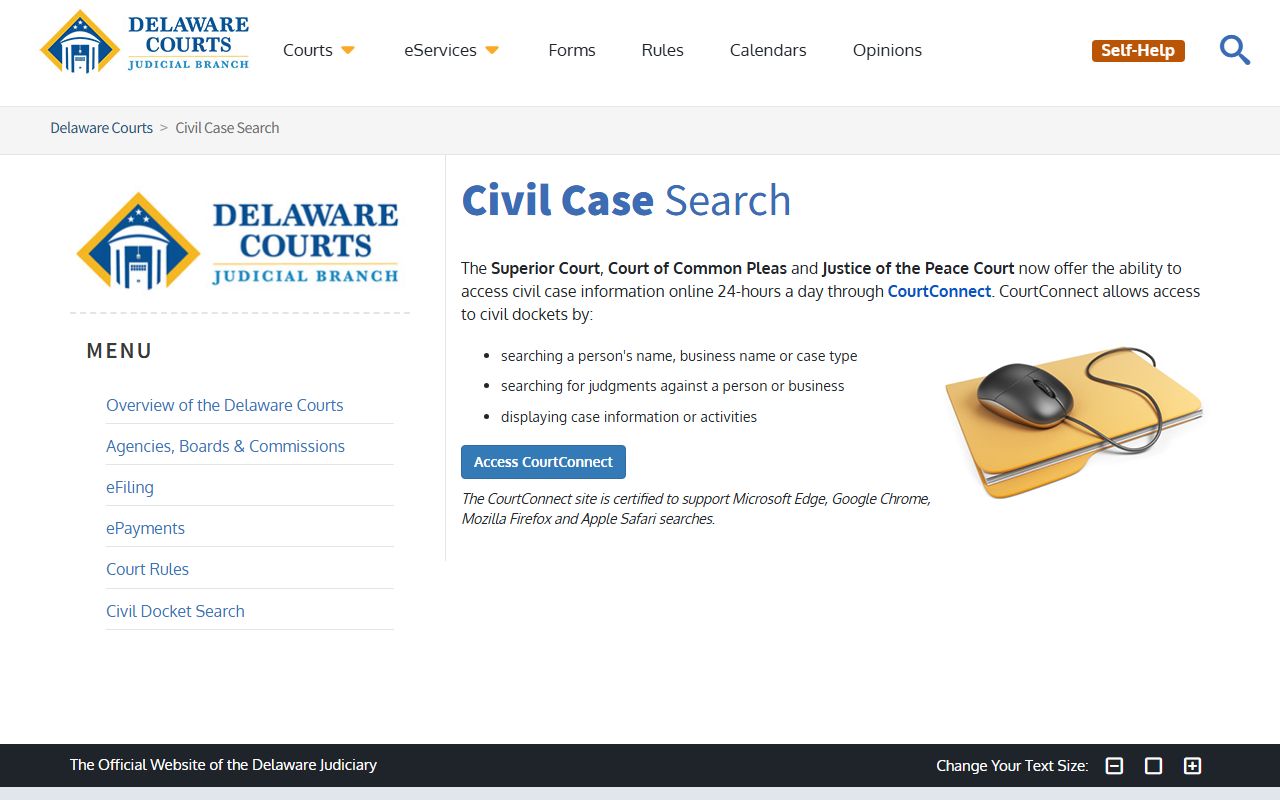
The Delaware Civil Case Search portal provides 24-hour access to civil docket information across the Superior Court, Court of Common Pleas, and Justice of the Peace Court.
Looking Up Traffic Violations in Delaware
Finding a specific traffic violation usually starts with the ticket. The ePayment system lets you search by case number or ticket and summons number. Enter your last name along with one of those numbers at the DELJIS ePayment portal, and the system pulls up any fines payable by voluntary assessment or under a payment agreement with a participating court. This tool only shows cases that are eligible for online payment. Not every case will appear, and some courts opt out of certain payment methods.
If the ticket was for parking in a municipality, that search may need to go through the relevant Alderman's Court's system if one exists. For civil traffic proceedings in the Court of Common Pleas or Justice of the Peace Court, CourtConnect is the right starting point. Delaware also allows you to order your driving record from the Division of Motor Vehicles, which maintains a central log of traffic convictions reported by all courts in the state within the required reporting windows.
Delaware Traffic Court Records and What They Contain
A Delaware traffic court record file typically contains the motorist's personal information, the charges listed on the citation, exhibits used during the proceeding, and a case docket showing each action taken. These records are held by the court where the case was filed. A records custodian at each court location manages public access requests. Standard paper copies cost $0.25 to $0.50 per page. Certified copies can cost up to $15 or more depending on the court and record type. For Superior Court records in New Castle County, certified copies cost $15 for the first three pages and up to $2 for each page after that, with a possible retrieval fee of $25 per record.
Public access to court records in Delaware is governed by the state's Freedom of Information Act under Title 29, Chapter 100. Most traffic court records are accessible to anyone unless sealed by court order. Non-public records include juvenile filings, social security numbers, driver's license numbers, identifying details about crime victims, and certain family court materials. Same-day processing is common for in-person copy requests. Mail requests for certified copies can take up to 10 business days.
How to Request Traffic Court Records in Delaware
The primary form for requesting records from the Justice of the Peace Court is MISC Form 35, the Application for Access to Court Records. This form asks for your contact information and details about the case: the defendant's name, JP Court number, case number, arrest or ticket number, date of birth for criminal matters, and the lead charge if you know it. You can submit it in person, by mail, or by fax to the specific JP Court location where the case was filed. Once the court receives your request, staff will contact you to arrange payment and document delivery.
Fees for JP Court records vary by request type. A criminal disposition record costs $7.00. A criminal certified copy also costs $7.00. Civil certified copies are $10.00. Civil docket pages cost $0.25 each. Audio recording CDs cost $25.00. All payments go to the State of Delaware by check or money order. For Court of Common Pleas records, email the records office at ccprecords@delawarecourts.gov and the office will confirm the cost before you pay. For Superior Court records in New Castle County, mail or hand-deliver the Application for Access to Court Records to the Leonard L. Williams Justice Center, 500 N. King St., Wilmington, DE 19801, or email prothonotary@delawarecourts.gov.
Persons who want to request access to JP Court public records can also download the Justice of the Peace Court Policy on Public Access to Court Records from the Delaware Courts' official website for full guidance on what to include in a written request.
Note: In-person requests at JP Court locations are often handled the same day, while mail requests for certified copies can take up to 10 business days depending on court workload.
Speed Laws and Fines Under Delaware Title 21
Delaware's motor vehicle laws live in Title 21 of the Delaware Code. Speed violations carry per-mile fines on top of the base fine. For a first offense that exceeds the posted limit by more than 5 but less than 16 miles per hour, the extra fine is $1.00 per excess mile. A second offense in that range costs $2.00 per mile over the limit.
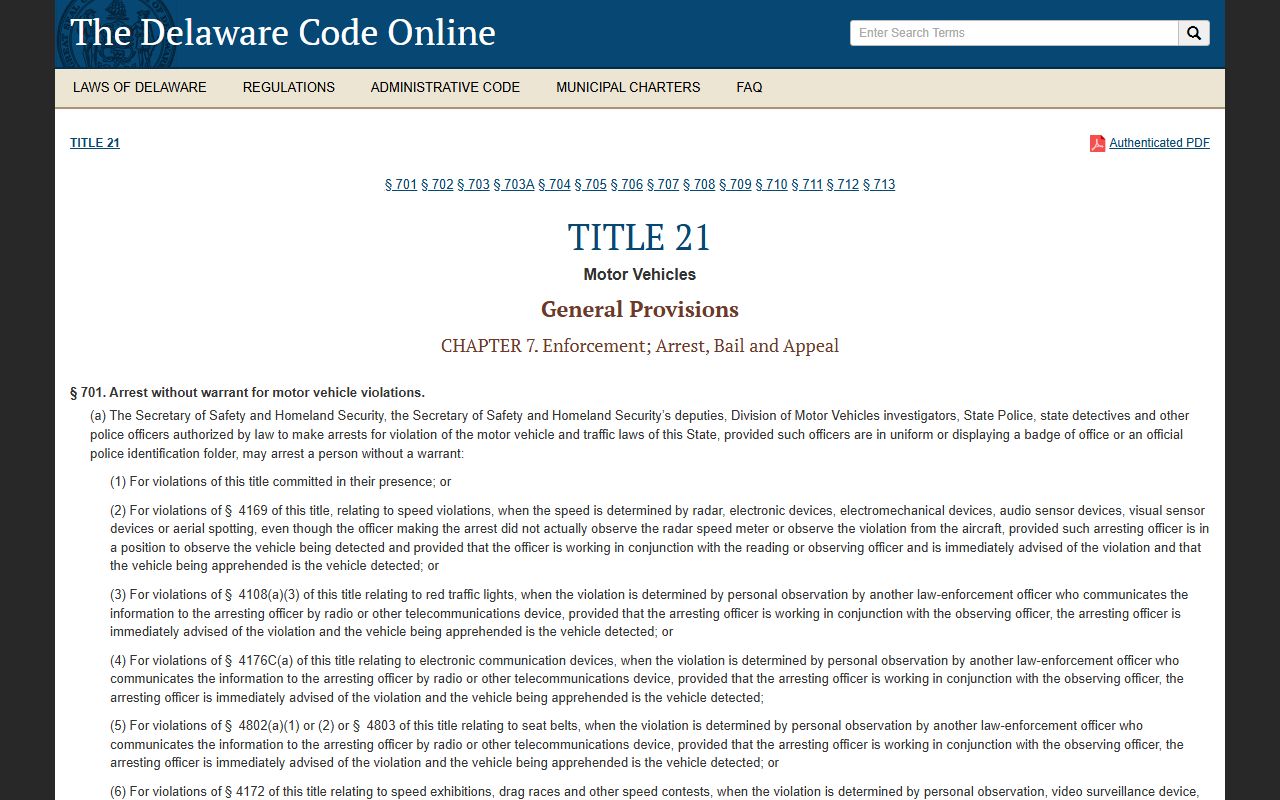
Title 21, Chapter 7 of the Delaware Code defines how traffic arrests are made, which courts hear the cases, and how conviction records are reported to the Division of Motor Vehicles.
Drivers who exceed the limit by more than 15 but less than 20 miles per hour face $2.00 per excess mile on a first offense and $3.00 per mile on a second offense. Going more than 19 miles over the limit costs $3.00 per mile for a first offense and $4.00 per mile for a second. The Department of Transportation sets a maximum of 65 miles per hour on Delaware Route 1 between Red Lion Creek and the Appoquinimink River, excluding the toll plaza area. These per-mile calculations become part of the fine record in every speeding case. All of that data goes into the traffic court record and gets reported to the DMV after the case closes.
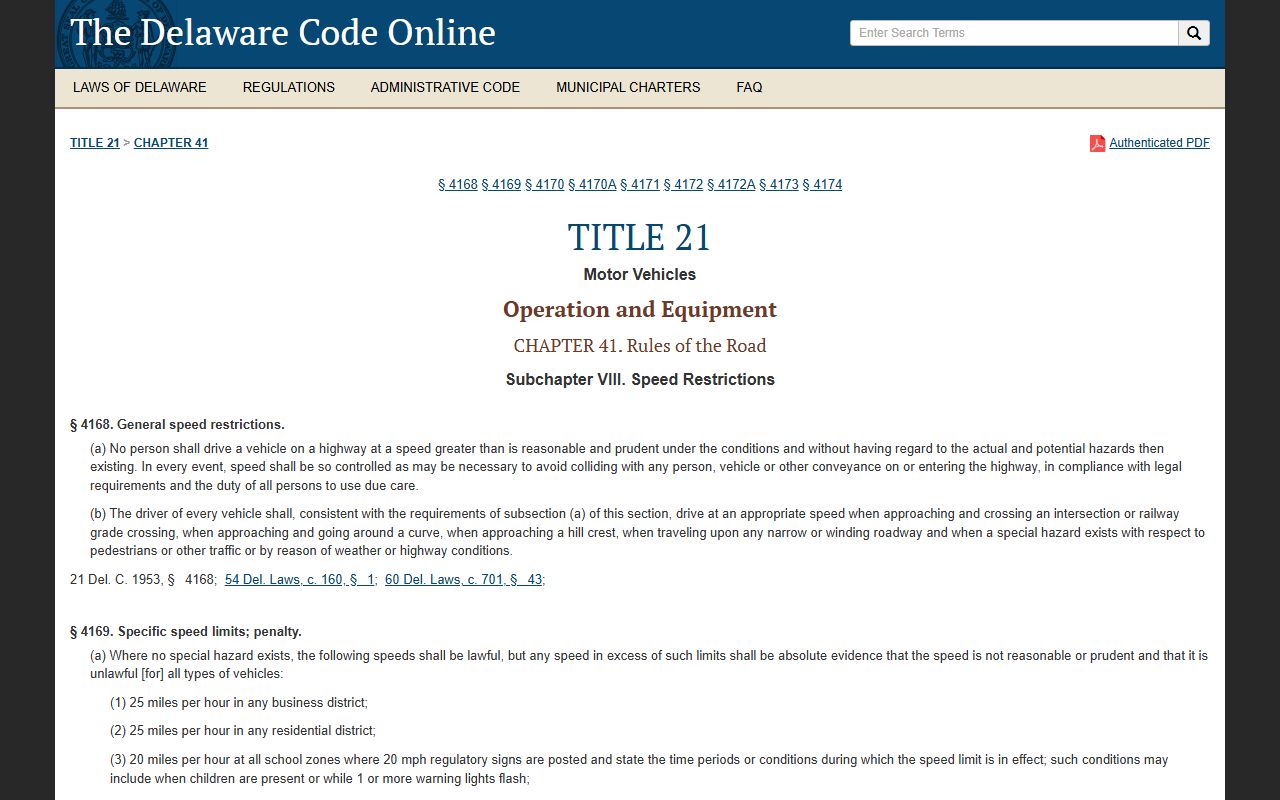
Title 21, Chapter 41, Subchapter 8 contains the specific speed restriction statutes and per-mile fine schedules that apply to every speeding violation across Delaware.
Reckless Driving Records and Penalties
Reckless driving in Delaware means operating a vehicle with willful or wanton disregard for the safety of people or property. No driver may go 90 miles per hour or more on any public road under any circumstances. A first reckless driving offense carries a fine of $100 to $300, up to 30 days in jail, or both. No suspended sentence is available for reckless driving, though the imprisonment term itself may be suspended on a first offense. For a second or later offense within three years, the fine rises to $300 to $1,000 with jail time between 30 and 60 days.
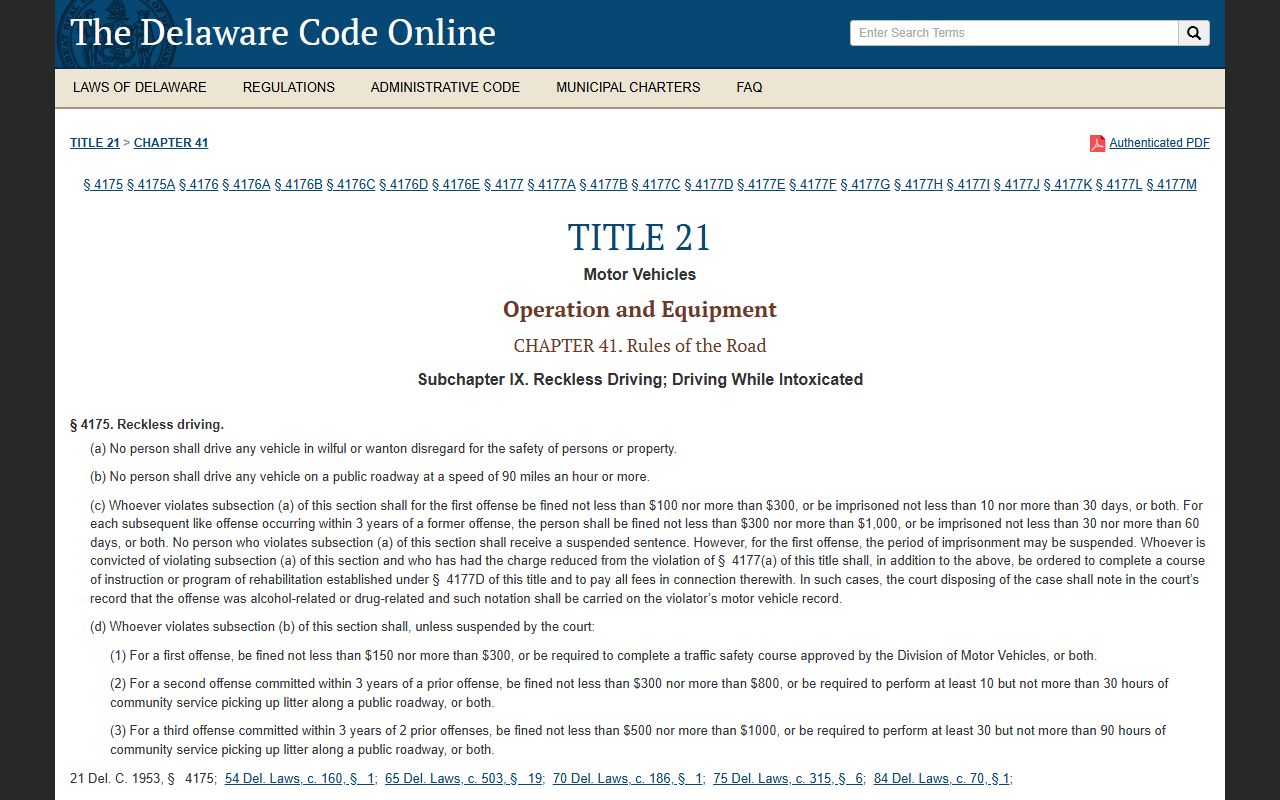
Title 21, Chapter 41, Subchapter 9 defines reckless driving in Delaware and sets the fine and imprisonment ranges for both first-time and repeat offenders.
Drivers convicted of reckless driving when their charge was reduced from a DUI must also complete a rehabilitation program under Title 21 Section 4177D and pay all fees tied to that program. Going 90 miles per hour or more carries its own penalty. A first offense at that speed requires a fine between $150 and $300 or completion of a traffic safety course approved by the Division of Motor Vehicles, or both. Reckless driving cases are criminal proceedings, and the records they generate stay in the court file at the Justice of the Peace Court or Court of Common Pleas where the case was heard.
DUI and Serious Traffic Court Records
A DUI in Delaware is a misdemeanor for a first and second offense. First-time offenders can face a fine up to $1,500 and up to 12 months in jail. A second DUI within 10 years brings a fine up to $2,500 and at least 60 days but no more than 18 months of incarceration. A third DUI at any point in life is prosecuted as a Class G felony, which carries a fine up to $5,000 and prison time from one year to two years. DUI charges cannot go through voluntary assessment and must be heard in court regardless of circumstance.
DUI cases begin in the Justice of the Peace Court for initial processing but are typically moved to the Court of Common Pleas Traffic Court. The Court of Common Pleas does not accept DUI appeals from the JP Court the same way it handles standard traffic matters. Felony traffic violations, which include third-offense DUI and other serious motor vehicle crimes, carry the longest sentences and the most severe license consequences. The full Title 21 statute on Justia provides chapter-by-chapter navigation through all DUI and motor vehicle offense provisions.
Title 21 of the Delaware Code on Justia covers DUI penalties, felony traffic offenses, and all motor vehicle violations that generate criminal court records in Delaware.
Note: A third Delaware DUI is treated as a Class G felony regardless of when the previous offenses happened, with no minimum gap between convictions required to trigger the upgrade.
The Delaware Voluntary Assessment System
Delaware's voluntary assessment program lets drivers pay certain traffic fines without going to court in person. When an officer issues a ticket eligible for voluntary assessment, the Uniform Traffic Complaint and Summons will note that the fine can be paid this way. The driver has 30 days from the date of the stop to pay the fine, costs, and any penalty assessment to the court or voluntary assessment center shown on the ticket. Paying by that deadline closes the case. Payment is treated as an admission of guilt, a waiver of any right to a hearing, and a complete satisfaction of the violation.
Not all offenses qualify. DUI, driving after judgment is prohibited, violations of certain safety statutes, and several other serious offenses cannot be resolved through voluntary assessment. They must go before a judge. For eligible offenses, payments can be made online through the DELJIS ePayment portal, which accepts MasterCard, Visa, and Discover. Prepaid cards with per-use surcharges are not accepted. You need a case number or ticket number and your last name. All online transactions are non-refundable. You can also mail payment to the Voluntary Assessment Center at P.O. Box 7039, Dover, DE 19903, or call (302) 739-6911 after faxing a signed ticket for confirmation.
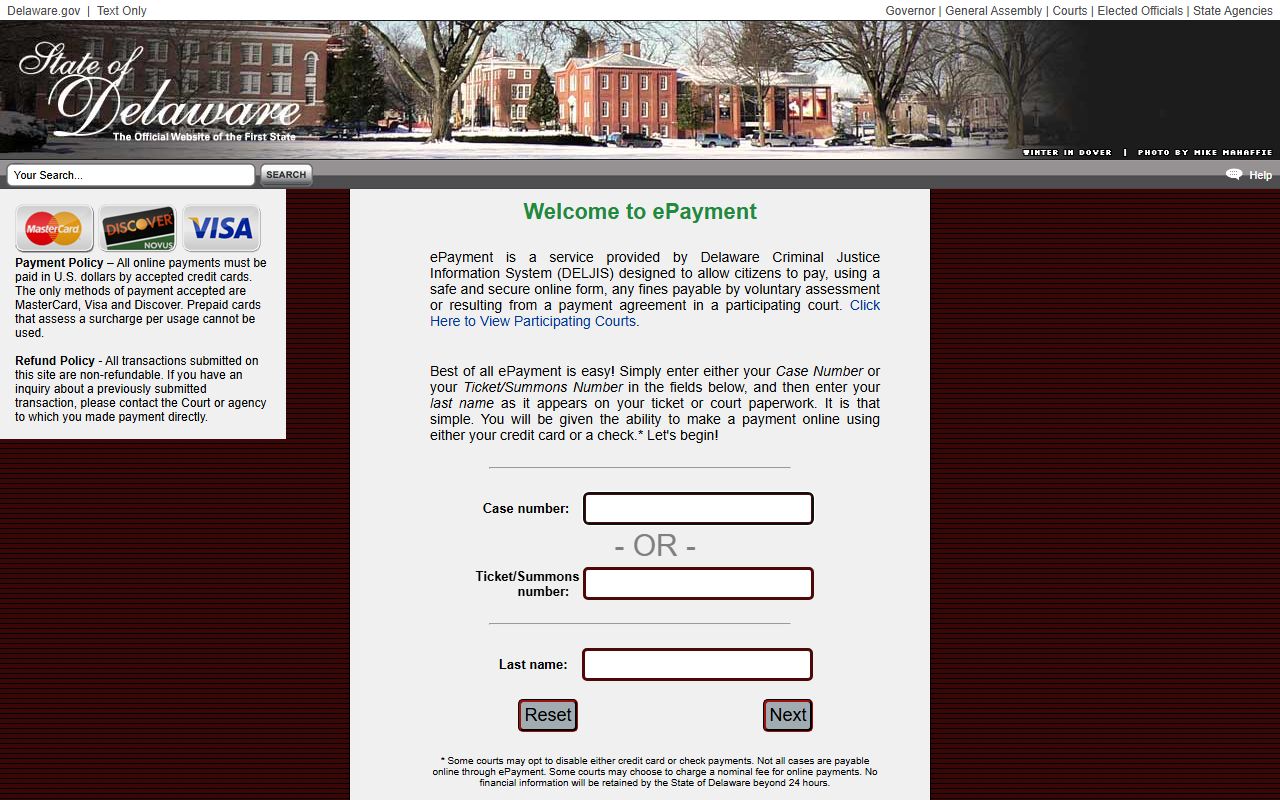
The DELJIS ePayment portal allows Delaware drivers to pay eligible traffic fines online using a case or summons number and accepts major credit cards through a secure system.
The in-person voluntary assessment center serves all JP Court traffic tickets at 480 Bank Lane, Dover, DE 19904, phone (302) 739-6911. The City of Wilmington runs its own separate voluntary assessment center exclusively for parking summonses issued within city limits, which is a different system from the statewide center.
If you want to fight the ticket instead of paying, you can plead not guilty by faxing or mailing your signed ticket answer to the JP Court listed on the summons before the 30-day window closes. Call (302) 739-6911 after faxing to confirm receipt.
Browse Delaware Traffic Court Records by County
Delaware has three counties, each with its own Justice of the Peace Court locations and a courthouse for the Court of Common Pleas. Select a county below to find local court addresses, phone numbers, and resources for traffic court records in that area.
Traffic Court Records in Delaware Cities
Several Delaware cities operate Alderman's Courts for local traffic violations, while others rely on county-level Justice of the Peace Courts. Select a city below to find the specific court that handles traffic cases in that area.